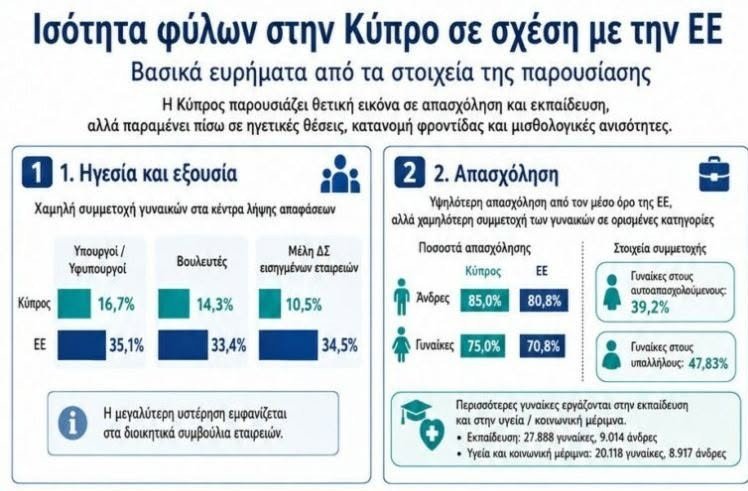
Recent data on gender equality and the labor market in Cyprus reveal a clear structural contradiction. On one hand, Cyprus demonstrates exceptional performance regarding the educational attainment of women. 72.9% of women aged 30–34 hold a tertiary education degree, a figure significantly higher than the European average (50.2%). Furthermore, the female employment rate reaches 75%, surpassing the EU average (70.8%), while overall unemployment remains low.
On the other hand, this academic superiority does not translate into commensurate representation within senior management and decision-making roles. According to data presented at a seminar organized by ICPAC (ΣΕΛΚ) in collaboration with the Ministry of Labour and the Human Resource Development Authority (AnAD), women’s participation on the boards of directors of major listed companies stands at only 10.5% (compared to 34.5% in the EU), while their representation in managerial and administrative positions is 26.8%. Underrepresentation is even more pronounced among self-employed female managers (2.65%) and in political office, where women hold only 16.7% of ministerial or deputy ministerial positions and 14.3% of parliamentary seats.
At the same time, despite a significant narrowing of the gender pay gap in recent years, from 22.5% in 2002 to 11.8% in 2024, there remain substantial pay disparities favoring men in highly specialized fields, such as senior management, accounting, actuarial science, and statistics. Furthermore, there is a clear pattern of occupational segregation: women are concentrated primarily in education, healthcare, and social services, while remaining underrepresented in cutting-edge sectors like Information and Communication Technologies (20.1%).
A key factor sustaining this glass ceiling is the unequal distribution of unpaid labor. In Cyprus, 62.5% of women engage in daily household chores (compared to 23.8% of men), while 42.8% dedicate more than 35 hours per week to childcare (compared to 14.8% of men).
The research approach confirms that the problem in Cyprus does not stem from a lack of qualifications, but rather from social and structural rigidities. Addressing this phenomenon requires targeted corporate governance policies, the strengthening of social care infrastructure, mechanisms for pay transparency and substantive measures to bridge the gap between education and advancement into leadership roles.