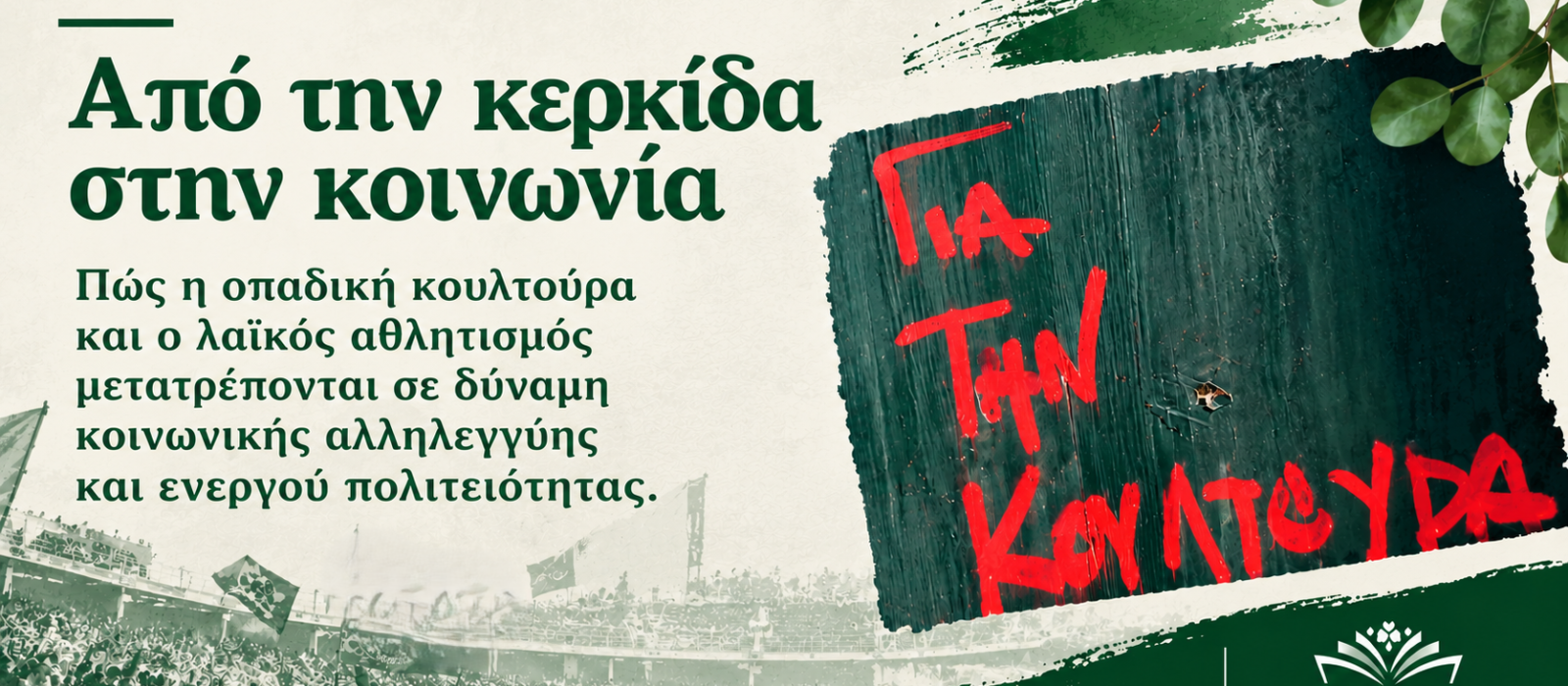
Is a fan merely a spectator, or can they also be an active citizen? Can the collective energy generated in the stands extend beyond the confines of the stadium and create a social impact?
Fan culture is a complex social phenomenon, often viewed through the lens of violence, hooliganism and delinquency. While these issues are indeed present within the sporting landscape, they do not capture the full reality of fan culture. Beyond the stands, communities emerge-forged by strong bonds, shared values and a capacity for collective organization-that can play a significant role in social life.
Solidarity, volunteering, the defense of social rights, the preservation of historical memory and anti-racist activism are all examples of how fan identity can take on a broader social dimension. In this context, grassroots sports can serve not only as a means for physical activity and recreation but also as a space for democratic participation, social cohesion and cultural expression.
Omonoia 29th of May as an example of participatory sports.
A prime example of this approach is the grassroots sports club Omonoia 29th of May. Its operational model is based on ownership and participation by its members, with the principle of “one member, one vote” serving as a cornerstone of its democratic organization.
Through General Assemblies and collective decision-making processes, members have the opportunity to actively shape the club’s direction. This model aligns with the international philosophy of fan-owned clubs, sports organizations that belong to their fans and members.
This approach challenges the perception of the fan as merely a consumer of a sports product, highlighting instead their capacity to participate meaningfully in the governance and operation of a sports organization. In this way, sports are viewed as a social good and a collective endeavor, drawing upon the historical and cultural legacy of 1948.
Solidarity as an everyday practice
The social dimension of fan culture becomes even more apparent through the voluntary and humanitarian initiatives of THYRA 9 (GATE 9 – organised fans of O29M) .
- Visits to hospitals-especially during the holiday season-are among their signature activities. Under the slogan “No child without a gift,” they organize gift distributions for children, conveying a message of tangible solidarity and social care.
- Furthermore, the formation of a team of trained volunteer firefighters and their active involvement during fire incidents, highlights the capacity of organized communities to contribute to the protection and support of society in times of need.
- Also significant are the volunteer blood drives and charitable initiatives they organize, most notably during the COVID-19 pandemic, a period when social solidarity and collective mobilization took on even greater importance.
These actions demonstrate that the bonds forged within a fan community can be harnessed to support individuals and groups facing hardship.
From the Stands to the Pursuit of Social Rights.
Active participation is not limited to charitable or voluntary activities; it also manifests through involvement in social struggles and collective advocacy.
- In 2018, the club and Gate 9 participated en masse in a march by educators toward the Presidential Palace, as part of a broader mobilization to defend public education.
- Similarly, initiatives to collect food, clothing, and essential supplies were organized to support vulnerable social groups.
- Even during the pandemic, when restrictive measures prevented physical attendance at collective demonstrations, public stances were taken in support of labor rights and the significance of International Workers’ Day (May Day).
These examples highlight a different dimension of fan identity: its capacity to connect with broader social issues and engage in public discourse.
Antifascism, Antiracism and Historical Memory
The social and cultural engagement of the fan community also extends to issues of equality, acceptance and historical consciousness.
- The annual organization of an anti-racist tournament by GATE 9 is an initiative that leverages sports as a common meeting ground for promoting equality, regardless of origin or social background.
- Furthermore, the display of banners with anti-racist, anti-war and social themes conveys messages of social awareness within the public sphere of sports.
- Also of particular significance is the annual march with the slogan “We do not forget the invasion, we do not forget the occupation”, an expression of a commitment to preserving historical memory and to pursuing reunification and justice for Cyprus.
These initiatives demonstrate that the sports stands can serve as a space for expressing social values, historical consciousness and collective identity, extending well beyond the narrow confines of athletic rivalry.
When sports become a matter for society at large.
The case of Omonοia 29th of May illustrates how fan culture can be linked to social contribution, democratic participation and active citizenship. When fans take part in the governance of their club, organize volunteer initiatives, support vulnerable groups and engage with issues that concern society, sports take on a broader social role.
This does not mean that problems of violence and delinquency in sports cease to exist nor that they should be ignored. It does mean however, that fan culture cannot be reduced to one-dimensional representations. One must also recognize the forms of collective organization, solidarity and social engagement that develop within fan communities. Ultimately, the strength of a sports community is not reflected solely in its presence in the stands or its results on the field of play. It is also reflected in its relationship with society, its capacity for mobilization and its contribution toward creating a more participatory and supportive society.
Guided by history, collectivity and solidarity, the stands can serve as a starting point for social action.
For sports are more than just a spectacle; they also entail participation, responsibility and a contribution to society.