Every July 20th, the sirens awaken the same memories. We speak of the losses, the territories and the political ramifications of the Cypriot tragedy. Yet, behind the maps and military reports lies a human geography that has remained in the shadows for decades. It is the story of children who, in the summer of 1974, were forced to grow up in a matter of hours.
What does it mean for a child to lose their home? That is the initial shock. But what does it mean to suddenly find oneself completely alone, without a parent’s hand to hold, amidst the maelstrom of war, fear and displacement?
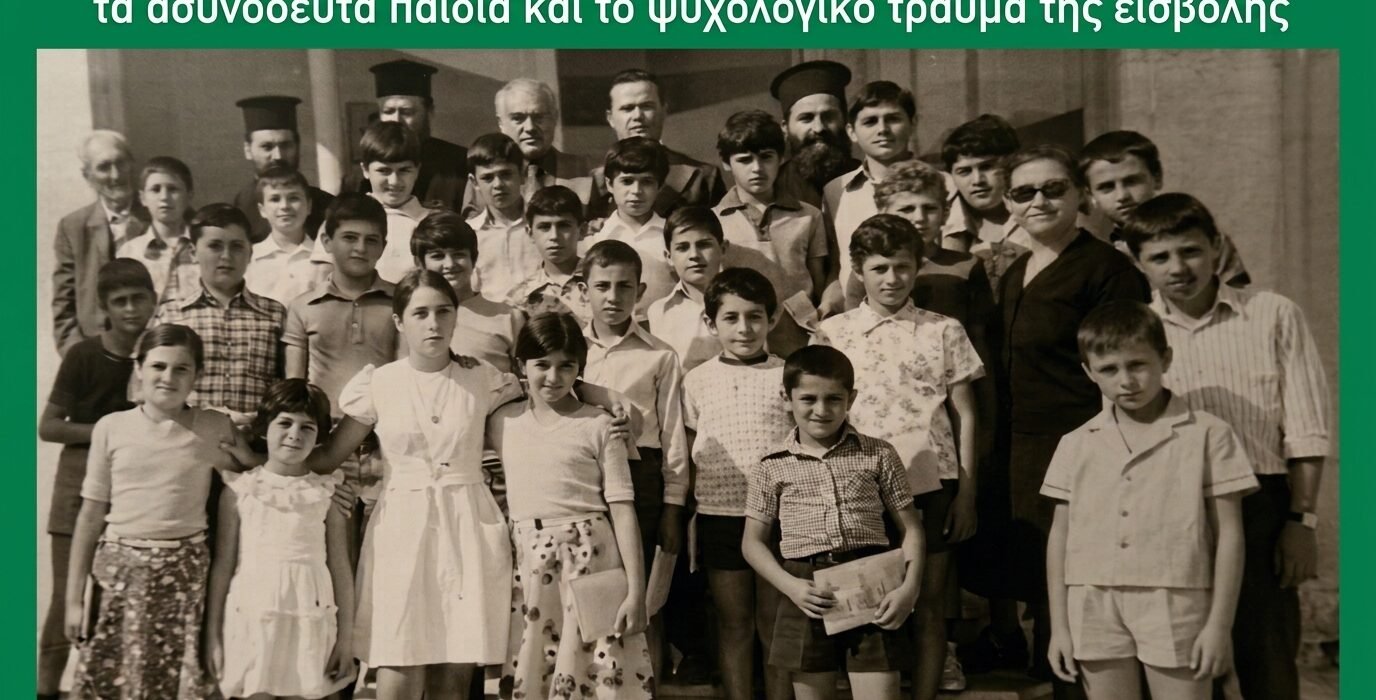
In the summer of 1974, hundreds of children in Cyprus were forcibly separated from their families and sent to Greece for safety, far removed from everything familiar. To the state, it was a rescue operation. To the child’s psyche, however, it was a profound and unexpected uprooting, a trauma that does not bleed outwardly, yet leaves an indelible mark on one’s adult life.
The science of psychology teaches us that childhood trauma does not fade with the passage of time; it merely takes on a different guise. Phobias, a sense of insecurity and the persistent feeling that everything could be lost at any moment. This is the psychological imprint still carried today by those who, as unaccompanied children, lived through that dark July.
Fifty-two years later, it is time to open this chapter. Not to reopen old wounds, but to foster understanding, to give a voice to a silent generation that learned only to remain quiet and to survive. The history of Cyprus is defined not only by the battles fought in the trenches, but also by the silent struggles that continue to this day within the souls of its people.
In light of this little-known aspect of our history, the Cultural Foundation 1948 is hosting an open discussion event on Wednesday, July 22, 2026, at 19:00, at the Capital Center (9 Evagorou Street, Nicosia).
The event aims to bridge historical documentation with psychological analysis. Journalist and historical researcher Michalis Michail will unfold the events and records of that era, bringing to light the untold story of these children. Panagiotis Stavrinides, Professor of Psychology at the University of Cyprus, will analyze the psychological imprint of uprooting, as well as the management of collective and individual trauma.
The discussion will be moderated by Argyris Ioannou.
We look forward to seeing you there, to listen, to learn and to ensure we do not forget the human side of our history.